Product Overview
YOMOV is a leading LBE VR distribution platform in China, bringing outstanding LBE VR content to audiences through physical venues. The YOMOV SDK enables developers to integrate with the platform quickly, connect their VR applications to the YOMOV Operations System, and complete the end-to-end distribution workflow.
Product Architecture
-
Product Communication Architecture
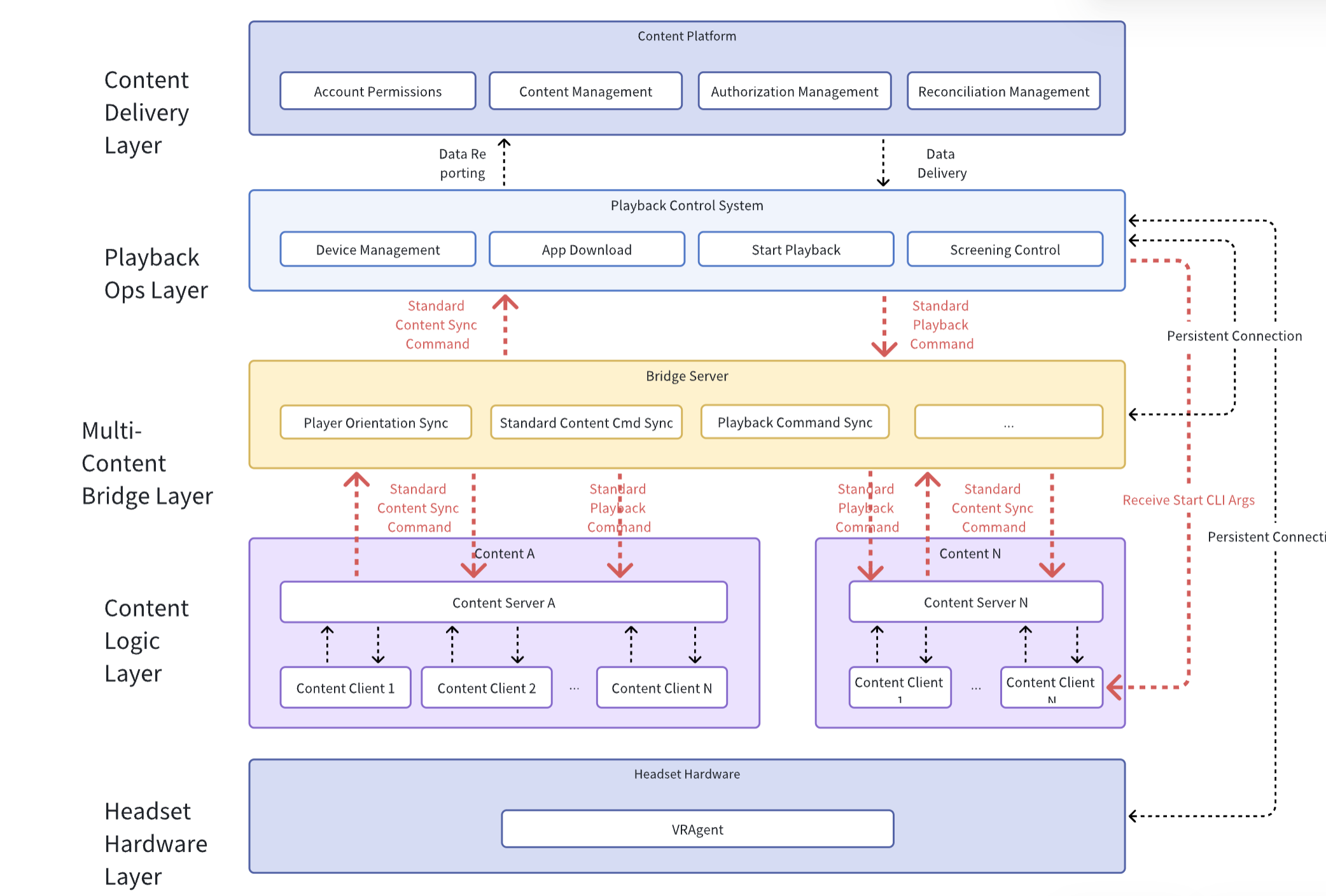
-
Product Functional Architecture
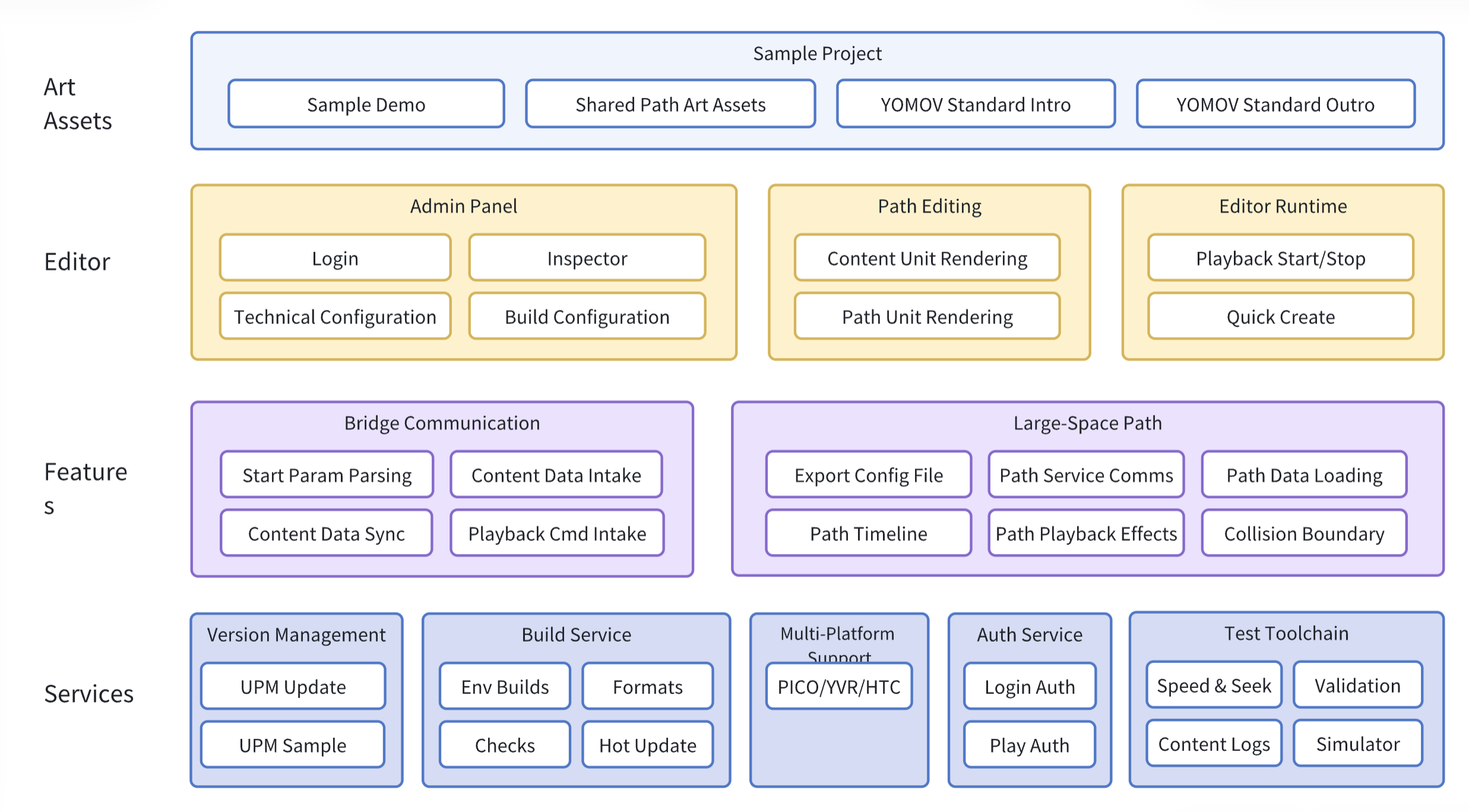
YOMOVSDK Core
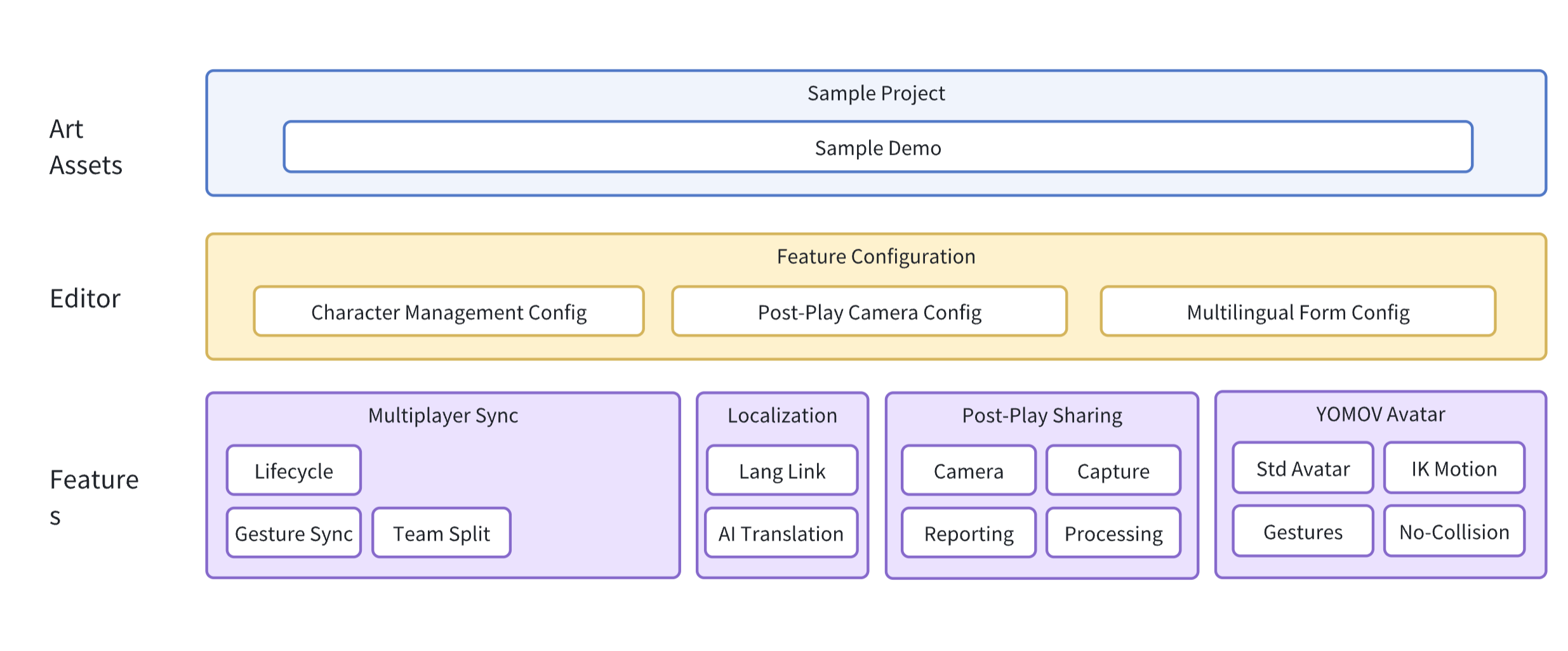
YOMOVSDK Creator
Feature Overview
The SDK consists of YOMOV SDK Core and YOMOV SDK Creator. SDK Core provides the mandatory integration required to distribute an application through the YOMOV platform, while SDK Creator provides productivity tools that streamline LBE VR application development.
SDK Package | Module | Description |
|---|---|---|
YOMOV SDK Core | Playback Authorization | Authorizes content playback by parsing the playback key issued at startup. |
Playback Control System Communication | Reads and parses startup parameters and runtime control commands from the YOMOV Playback Control System. | |
Bridge Data Synchronization | Receives and forwards multi-application data through the bridge server. | |
LBE Path | Provides the complete workflow for creating path units, configuring parameters, exporting configurations, and running LBE VR experiences. | |
Multi-Device Support | Supports mainstream headsets and device models from PICO, YVR, and HTC through OpenXR. | |
YOMOV SDK Creator | Multi-Application Bridge Synchronization | Synchronizes player data across applications by parsing and relaying data through the multi-application bridge. |
Player Avatar Animation | YOMOV standard player avatars with blended inverse-kinematics (IK) animations. | |
Localization | Provides multilingual localization that can be selected automatically by the Playback Control System. | |
Post-Experience Sharing | Automatically generates mixed-reality post-experience videos from player LBE VR sessions and on-site footage. | |
LBE VR Trailer | Configures Timeline clips in the application to quickly generate a VR trailer for prospective players. |
Core Concepts
LBE VR Experience Types
Based on core factors such as the experience format, interaction intensity, and on-site operating model, YOMOV classifies LBE VR content into two types: Free-Roam Experience and Small-Space Game.
Content partners (CPs) should classify their content by experience type and select the corresponding LBE path mode for integration.
Comparison Dimension | Free-Roam Experience | Small-Space Game |
|---|---|---|
Core Experience | Walking and viewing, narrative experiences, and immersive exploration | Frequent interaction, gameplay challenges, and action-oriented play |
Content Focus | Scene atmosphere, narrative pacing, character and story performances, and spatial exploration | Gameplay mechanics, interaction feedback, win/loss objectives, and level challenges |
Interaction Intensity | Low; primarily triggers, observation, simple choices, or lightweight interactions | High; includes continuous input, dodging, shooting, slashing, and cooperation |
Player Movement Intensity | Moderate; primarily natural walking and stationary viewing | High; may include rapid movement, turning, crouching or dodging, and large body movements |
Target Audience | Families, cultural-tourism visitors, exhibition audiences, casual players, and first-time VR users | Gamers, younger audiences, and team-challenge participants |
Venue Operating Model | Supports mixed-content operation; different groups or combinations of content can run in the same space | Usually operated in separated spaces to reduce interference between experiences or players |
Path Adaptation | Dynamic Path; maximizes player avoidance when multiple experiences share a venue | Fixed Path; enforces physical separation between players |
Integration Priorities | Path adaptation, narrative triggers, spatial alignment, and playback stability | Interaction logic, collision detection, multiplayer synchronization, input responsiveness, and performance stability |
LBE Path
An LBE Path is a core concept for understanding LBE VR distribution. The YOMOV SDK supports two LBE path modes.
- Dynamic Path
Overview: Scene content in a VR application is divided into discrete experience units called Acts. These segments are connected end to end as a path, creating a continuous walking experience across both virtual content and physical space. The core steps are defining path units and connecting path units.
Applicable content type: Free-Roam Experience
Functionality: The SDK defines content-unit elements, while the path server connects path units dynamically during venue operation. This enables precise adaptation to venue maps and maximizes player-avoidance scheduling.
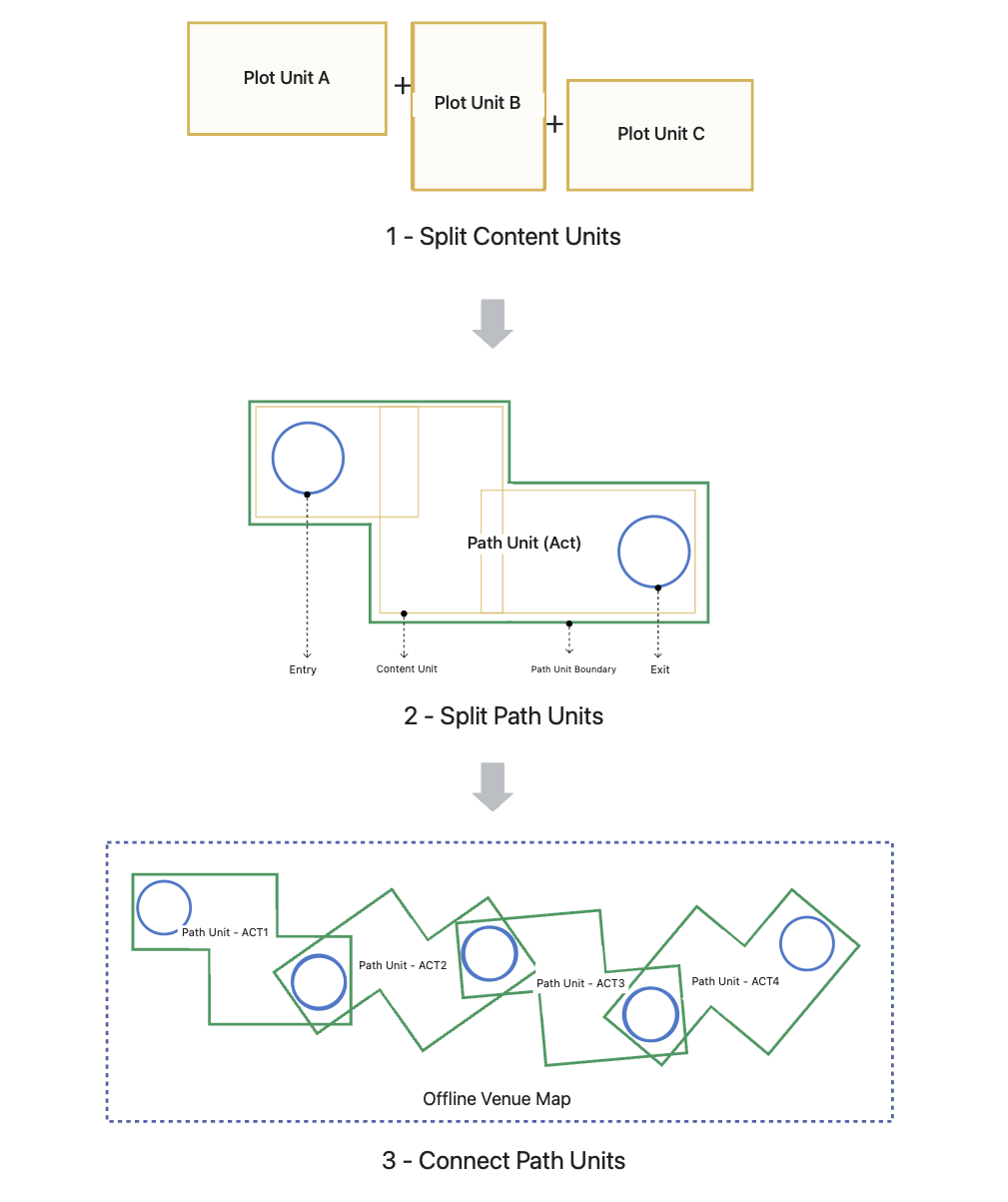
Dynamic Path
-
Plot (Content Unit)
-
Experience: The smallest content experience unit in LBE VR. Leaving a Plot boundary moves the player into the "Void Space."
-
Composition: One content experience boundary plus one or more narrative sequences.
-
Relationship: Multiple Plots form one Act.
-
-
Act (Path Unit)
-
Experience: The smallest continuous walkable-space unit in LBE VR. Moving between Acts rotates or offsets the content space.
-
Composition: One entry zone, one exit zone, and one continuous walkable area.
-
Distribution: The smallest spatial unit used for LBE VR distribution adaptation. A space-efficiency algorithm adapts it to different venue maps.
-
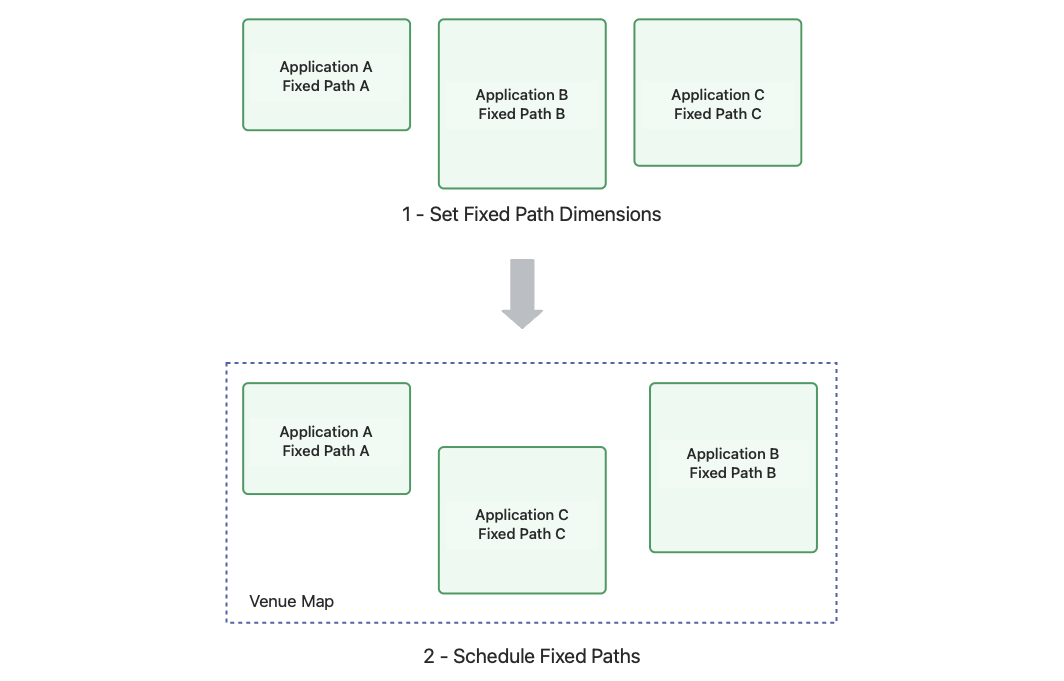
- Fixed Path
Overview: The entire LBE VR experience area is treated as a single path unit and scheduled dynamically within the venue.
Applicable content type: Small-Space Game
Functionality: The SDK defines one overall content experience boundary. The path server schedules this area to isolate different Small-Space Games, with a configurable level of separation.
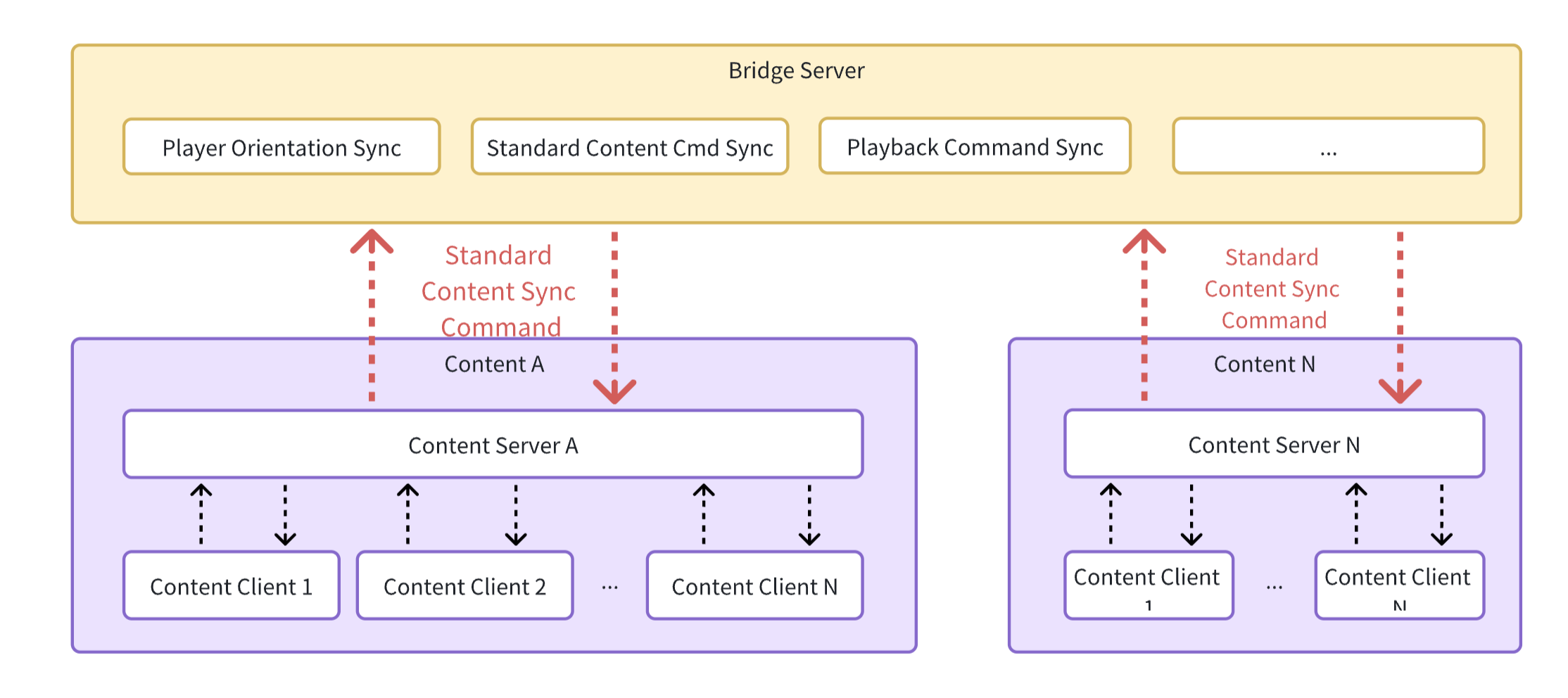
Multi-Application Bridge Synchronization
Overview: A bridge service synchronizes player pose data across applications, allowing multiple applications to operate concurrently in the same venue.
Functionality: The bridge server receives and forwards data from multiple application servers during playback. Each application server parses the bridged data, allowing different content experiences to run simultaneously in one venue.
Product Advantages
-
Global reach: YOMOV is a leading LBE VR distribution platform, currently operating in more than 80 venues across three countries and continuing to grow steadily.
-
Streamlined SDK integration: The mature component-based SDK lowers the development barrier and enables technical integration and debugging within one week.
-
One-step distribution adaptation: The space-efficiency path algorithm automatically adapts content for YOMOV venues ranging from 60 to 400 m².
-
Comprehensive publishing services: After an LBE VR title launches, YOMOV supports multi-channel distribution, marketing, and managed operations.